
Relationship between SEO and Content Marketing

Introduction: More Than Partners – A Digital Ecosystem for Organic Growth
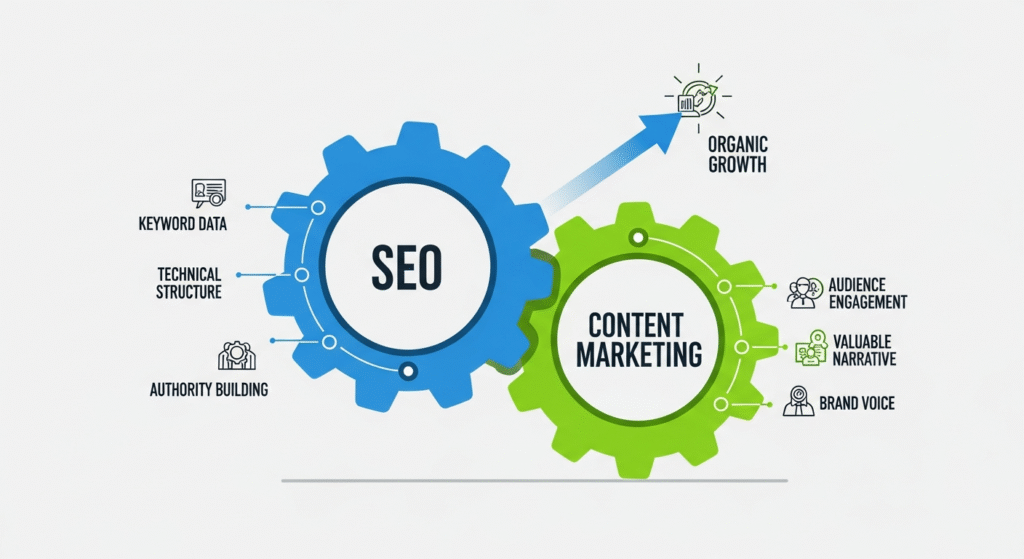
In the digital landscape, businesses often treat Search Engine Optimization (SEO) and content marketing as separate disciplines, managed by different teams with distinct goals. One focuses on the technical architecture of discoverability, while the other centers on narrative and audience engagement. This siloed approach, however, fundamentally misunderstands their relationship. SEO and content marketing are not merely partners; they are two halves of a single, symbiotic organism, a digital ecosystem where one cannot achieve its full potential without the other. True, sustainable organic growth is born from their complete integration.
Defining the Symbiosis in Digital Marketing
SEO provides the data-driven blueprint for what content to create, while high-quality content provides the substance that search engines and users value.
At its core, SEO is the science of making a website more visible and accessible to search engines. It involves technical optimization, keyword strategy, and authority building to improve rankings. Content marketing, conversely, is the art of creating and distributing valuable, relevant, and consistent content to attract and retain a clearly defined audience. The symbiosis occurs when SEO provides the data-driven direction for what content to create, and high-quality content provides the substance that search engines are designed to find and reward. Content gives keywords a purpose, and SEO gives content a platform.
The Pitfalls of Siloed Strategies: Why Integration is Non-Negotiable
When separated, both strategies underperform. An SEO strategy without a strong content component becomes a technical exercise with no substance to rank. You might have a perfectly optimized site structure, but if it leads to thin or irrelevant information, search engines like Google will see no reason to rank it highly. Conversely, brilliant content created without SEO guidance is like a masterpiece hidden in a locked room. It may be valuable, but if no one can find it through a search, its impact on generating traffic, leads, and business growth is severely limited.
What You’ll Learn: A Framework for Holistic Organic Growth
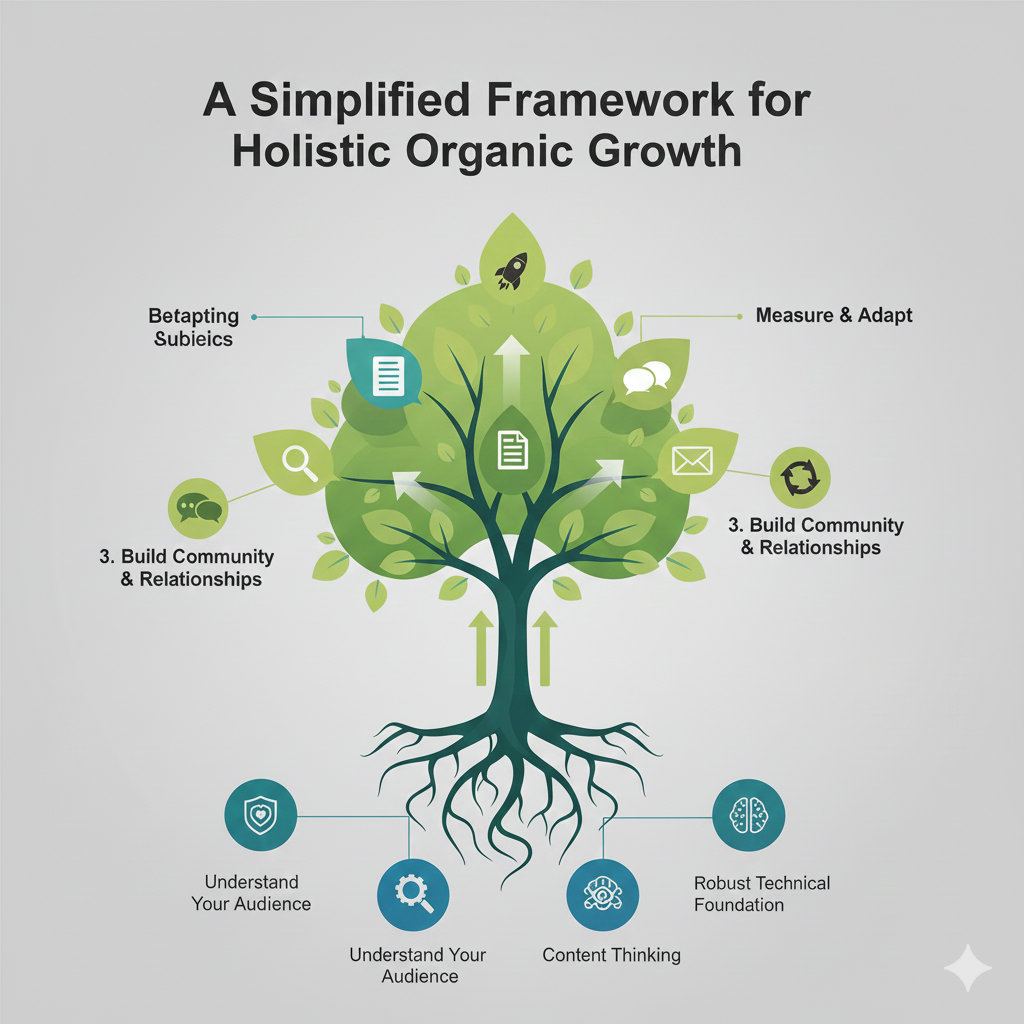
This article will dismantle the siloed approach by providing a comprehensive framework for integrating SEO and content marketing. We will explore how their shared foundation in user intent drives success, how content fuels SEO’s authority, and how SEO navigates content to its intended audience. By understanding this interdependent relationship, you can build a holistic strategy that drives meaningful, long-term organic growth.
The Shared Foundation: Unearthing User Intent with Strategic Keyword Research
The convergence of SEO and content marketing begins with a single, critical objective: understanding and satisfying user intent. Before any content is written or a single line of code is optimized, both disciplines must align on what the target customer is searching for and why. This is where comprehensive keyword research serves as the non-negotiable bedrock.
Comprehensive Keyword Research as the Bedrock for Both Disciplines
Keyword research is much more than generating a list of popular terms. It is the process of market analysis for the digital age. For SEO, it identifies the queries that will drive qualified traffic. For content marketing, it reveals the questions, problems, and pain points of the audience, providing the raw material for a relevant content strategy. This shared starting point ensures that technical optimization and creative efforts are aimed at the same target.
Understanding Searcher Intent: The “Why” Behind Every Query
Modern search engine algorithms have evolved far beyond simple keyword matching. They prioritize understanding the intent behind a search. Intent can generally be categorized into four types: informational (wanting to know something), navigational (wanting to go to a specific site), transactional (wanting to buy something), and commercial investigation (comparing products before a purchase). A successful integrated strategy uses keyword research to decipher this intent, allowing the business to create content that provides the right answer at the right stage of the customer journey.
Bridging the Gap: From Keyword Insights to Compelling Content Topics
The true power of integrated keyword research is its ability to bridge the gap between raw data and compelling content. A high-volume keyword like “project management software” is a starting point. Deeper analysis reveals long-tail keywords like “best project management software for small teams” or “how to integrate project management software with CRM.” These specific queries not only have clearer intent but also serve as direct prompts for blog posts, comparison guides, or tutorials that a content team can create, perfectly aligning the final product with a user’s search.
Leveraging Tools for Deeper Keyword Analysis (e.g., Google Keyword Planner)
To perform this level of analysis, leveraging specialized tools is essential. Platforms like Google Keyword Planner, Ahrefs, and SEMrush provide critical data on search volume, keyword difficulty, and related queries. These tools help teams identify opportunities, analyze competitor strategies, and uncover the language their target audience uses. By using these insights, both SEO and content teams can operate from a single source of truth, ensuring every piece of content is strategically positioned to perform well in a search.
Content Marketing as SEO’s Engine: Fueling Visibility and Authority
If keyword research is the blueprint, high-quality content is the engine that powers the entire organic growth machine. Without compelling, valuable, and strategically crafted content, even the most technically sound SEO strategy will fail to gain traction. It is the content that earns links, engages users, and signals expertise to search engines, thereby building the authority necessary for high rankings.
Crafting High-Quality, User-Centric Content That Converts
High-quality content is defined by its ability to satisfy the user’s intent completely and effectively. It should be well-researched, accurately written, and presented in a clear, digestible format. For a search engine like Google, quality is often measured through user engagement signals. When a user clicks on a search result and spends significant time on the page, it indicates that the content is relevant and valuable. This positive user experience is a powerful signal that boosts rankings, turning website traffic into potential leads.
Building Topical Authority and Industry Expertise (Google’s E-E-A-T)
Google’s ranking guidelines heavily emphasize E-E-A-T: Experience, Expertise, Authoritativeness, and Trustworthiness. A business cannot achieve this by publishing a single article on a topic. It requires developing a comprehensive content strategy that covers a subject area in depth, creating a “topic cluster.” By consistently publishing insightful and helpful content around a core theme, a website signals to search engines that it is an authority in that niche. This topical authority makes it easier for all related content on the site to rank.
Incorporating Semantic SEO and LSI Keywords for Contextual Richness
Modern search engine optimization has moved beyond a rigid focus on primary keywords. Semantic SEO involves optimizing for topics, not just strings of text. A key component of this is the use of Latent Semantic Indexing (LSI) keywords—thematically related terms and phrases that a search engine uses to understand the context of a page. For an article about “car maintenance,” LSI keywords might include “oil change,” “tire rotation,” “brake pads,” and “engine diagnostics.” Including these terms naturally within the content creates a rich contextual web that helps Google understand the page’s topic with greater accuracy.
Diversifying Content Formats for Enhanced Engagement (e.g., Video Content, Infographics, Whitepapers)
Content is not limited to blog posts. Diversifying formats is crucial for engaging different segments of an audience and capturing various types of search visibility. Infographics are highly shareable and can earn valuable backlinks. Whitepapers and case studies can generate qualified leads. Furthermore, video has become a dominant force; according to Wyzowl, 82% of marketers report that video marketing has helped them increase website traffic. Each format provides a new opportunity to rank and satisfy user intent.
The Power of Evergreen Content for Sustained Organic Traffic
Evergreen content refers to topics that remain relevant and valuable over long periods, independent of trends or news cycles. A guide on “how to create a budget” or a tutorial on “basic photo editing” will continue to attract organic traffic for years. Focusing a portion of the content strategy on creating these foundational assets provides a stable baseline of traffic and authority, acting as a long-term investment in the website’s SEO performance.
Content Strategy: Mapping Content to the Buyer’s Journey and Marketing Funnel
An effective content strategy maps different pieces of content to specific stages of the buyer’s journey. Top-of-funnel content (awareness) might be educational blog posts that answer broad questions. Mid-funnel content (consideration) could be detailed guides or product comparisons. Bottom-of-funnel content (decision) might include case studies or free trial pages. This mapping ensures that the business is providing value to the customer at every step, guided by SEO insights into what users are searching for at each stage.
SEO as Content Marketing’s Navigator: Guiding Reach and Performance
While content is the engine, SEO is the sophisticated navigation system that guides it to the correct destination. It ensures that valuable content is structured, optimized, and connected in a way that allows search engines to find, understand, and rank it effectively. SEO provides the technical framework and strategic direction that maximizes the reach and impact of every content asset.
On-Page SEO: Optimizing Content for Search Engine Rankings
On-page SEO involves optimizing individual web pages to rank higher and earn more relevant traffic. This is where the content and SEO teams collaborate most closely. It includes the strategic placement of primary and LSI keywords in titles, headers (H1, H2, etc.), and body text. It also involves optimizing image alt text, ensuring a logical URL structure, and writing compelling meta descriptions to improve click-through rates from search results pages.
Technical SEO: The Unseen Foundation for Content Discovery (e.g., Core Web Vitals, Mobile-Friendly Design)
Technical SEO is the foundation upon which all content sits. If a search engine cannot efficiently crawl and index a website, even the best content will remain invisible. Key elements include site speed, mobile-friendliness, a clean site architecture, and the use of an XML sitemap. Google’s Core Web Vitals, which measure loading performance, interactivity, and visual stability, are direct ranking factors that depend on the site’s technical health. A strong technical foundation ensures a positive User Experience and allows content to be discovered without friction.
Strategic Link Building and Internal Linking for Authority and Content Flow (Link Juice)
Links are the currency of the web and a primary signal of authority to search engines. A strategic link-building effort, often centered on promoting high-value content, involves earning backlinks from other reputable websites. This passes authority, or “link juice,” to the site. Equally important is a robust internal linking strategy. By linking related articles together, you help search engines understand the relationships between your content, distribute authority throughout your site, and guide users to more relevant information.
Enhancing User Experience (UX) and User Engagement: Key Ranking Signals
User Experience (UX) has become a critical component of modern SEO. A website that is easy to navigate, visually appealing, and provides a seamless experience will keep users engaged longer. Metrics like dwell time (how long a visitor stays on a page) and bounce rate (the percentage of visitors who leave after viewing only one page) are indirect but powerful ranking signals. Good content contributes to good UX, and good UX tells search engines that the content is valuable, creating a positive feedback loop.
Meta Titles and Meta Descriptions: Crafting Compelling SERP Snippets
The meta title and meta description are the first impressions a user has of your content on a search engine results page (SERP). While the meta description is not a direct ranking factor, a well-written, compelling description that includes the target keyword can significantly increase the click-through rate (CTR). A higher CTR signals to Google that your result is highly relevant to the search query, which can positively influence your ranking over time. This is a perfect example of SEO and content (copywriting) working together.
The Integrated Strategy: Operationalizing the Symbiosis for Sustainable Growth
Understanding the symbiotic relationship between SEO and content marketing is the first step. The next, more critical step is to operationalize this integration within your organization. This requires breaking down departmental silos and creating a unified framework where data, insights, and processes flow seamlessly between teams to drive a singular goal: sustainable organic growth.
Developing a Unified Content and SEO Strategy Framework
A unified strategy begins with shared goals and Key Performance Indicators (KPIs). Instead of the content team focusing solely on engagement metrics and the SEO team on rankings, both should be accountable for organic traffic, keyword visibility, and lead generation. This framework should outline a collaborative process for keyword research, content calendaring, on-page optimization, and performance analysis, ensuring both disciplines are aligned from ideation to execution.
Collaborative Content Creation and Optimization Processes
In a truly integrated model, SEO is not an afterthought applied after content is written. It is part of the creation process. An SEO specialist should be involved in the content briefing stage, providing keyword targets, outlining searcher intent, and suggesting structural elements like H2s and H3s. After publication, the content should be monitored and periodically refreshed or optimized based on performance data, creating a continuous loop of improvement.
Content Promotion and Distribution Enhanced by SEO Insights (e.g., Social Media Marketing, Email Newsletters)
SEO insights can extend beyond the website to inform broader content promotion strategies. Understanding which topics and keywords are trending can help guide social media campaigns and email newsletter content. Furthermore, promoting content on social media and other channels can generate initial traffic and social signals that may indirectly influence search engine visibility and accelerate the process of earning natural backlinks.
The Role of AI in Amplifying SEO-Content Integration
Artificial intelligence is rapidly transforming both SEO and content marketing. The adoption of AI is accelerating, with 90% of content marketers planning to use AI to support their efforts in 2025. AI tools can analyze vast amounts of search data to identify content gaps and keyword opportunities at scale. They can assist in generating content outlines, optimizing for semantic relevance, and even predicting the performance of certain topics, allowing teams to make more data-driven decisions and amplify the efficiency of their integrated strategy.
Measuring the Holistic Impact: KPIs for Combined Success
To validate the effectiveness of an integrated strategy, measurement must also be holistic. Focusing on isolated metrics can provide a misleading picture. For instance, high rankings for a keyword are meaningless if they don’t result in traffic, and high traffic is a vanity metric if it doesn’t convert into leads or contribute to the business’s bottom line.
Beyond Individual Metrics: Tracking Organic Traffic and Website Visits
The most fundamental KPI for a combined SEO and content marketing effort is the growth of organic traffic. This metric directly reflects the success of content in ranking for target keywords and attracting users from search engines. Tracking overall website visits from organic search over time provides a clear, high-level view of the strategy’s impact. This should be further segmented to analyze traffic to specific content pieces or topic clusters to understand what is resonating most with both audiences and search algorithms.
Conclusion
The dynamic between SEO and content marketing is not one of simple collaboration but of profound interdependence. To treat them as separate functions is to cripple the potential of both. SEO without content is a skeleton without a soul; content without SEO is a voice without a microphone. True organic growth is achieved when these two disciplines merge into a single, cohesive strategy driven by a deep understanding of user intent.
The path forward requires a shift in mindset and operations. It involves building a unified framework where keyword research informs content creation, technical optimization supports content visibility, and performance data from both feeds back into a continuous cycle of refinement. By embracing this symbiotic relationship, your business can move beyond chasing fleeting algorithm changes and build a sustainable engine for attracting, engaging, and converting your target customer. The ultimate goal is not just to rank higher, but to become the most relevant answer for the questions your audience is asking, cementing your authority and driving long-term success.

About Krisna Sarkar
My name is Krisna Sarkar. I am a Digital Marketing Specialist, and the founder of Techno Glimpse.